Decide what to be and go be it.
Newsletter / Dec 2025
Advent of SQL and finding our place
Doing Advent of SQL, got strep throat, and thinking deeply about where humans fit in the AI equation.
Hey y'all,
This week has been a roller coaster, but mostly a good one. I've been doing Advent of SQL this week, which you can find at DatabaseSchool.com, where I release a new video each day walking through some Christmas-themed challenge. It's been a lot of fun, but also a little bit of pressure to get a video out each day, coinciding with getting the database playgrounds working from the browser.
Now I have it set up where students can interact with a live running database directly from their browser, which took a lot of infrastructure work, but I think is going to be really valuable moving forward for the people learning.
I also have strep throat. I am the fifth out of our sixth member family to get it. And let me tell you, I do not recommend it! I haven't had strep throat since I was a kid and it's much less fun as an adult because you don't get to stay home from school. You just go to work like normal. And in my case, you record videos with your throat on fire.
I'm also like two or three weeks behind on email. So I apologize for that if you've sent me something. Trying to keep the wheels on over here!
Thoughts from the week
As I've continued to feverishly explore AI, I'm trying to think about where we come in in the process. What is our value now?
I sincerely believe that a large part of the bottom of software development is being commoditized. I do not believe that the top part, the higher levels, have been commoditized yet. I still think there's a lot of room for infrastructure, architecture, patterns, principles, that sort of thing. But I don't think that typing out code by hand is going to be much of a thing in the future.
And so as a big part of my economic utility has been commoditized away, I'm left wondering what's next. I think database education will still need to exist for many, many years, but I'm under no illusions that that may eventually be commoditized away as well.
Part of this game is just staying alive, as we've talked about before, and so I'm trying to stay alive. I think the things I'm doing on databaseschool.com will preserve me for at least a few years, but I can't just rest on my laurels or stick my head in the sand and hope that nothing happens because I think something will happen.
It's also not a hair-on-fire situation yet. I think being on Twitter all the time, we're exposed to the bleeding edge and I don't think the rest of the world has quite caught up yet. And I think a lot of what we see on Twitter is hype. So I'm neither terrified nor super comfortable, which frankly is an OK place to be.
When everyone can build anything. What is your distinct advantage? I don't think we're to the place where everyone can build anything yet. But we're not heading away from that eventuality. I don't know how fast we're heading towards it, but we're not heading away from it.
Unfortunately, I still don't have any answers. You'll be the first to know when I do!
🎬 YouTube
Scaling DuckDB in the cloud with MotherDuck CEO Jordan Tigani
In this episode of Database School, I sat down with Jordan Tigani, co-founder and CEO of MotherDuck, to break down what DuckDB is, how MotherDuck hosts it in the cloud, and why analytics workloads are shifting toward embedded databases. Check it out on YouTube or your favorite podcast player.
Things I found this week
Just a heads up that each Twitter/X screenshot has a link to the original post if you want to go follow the account.
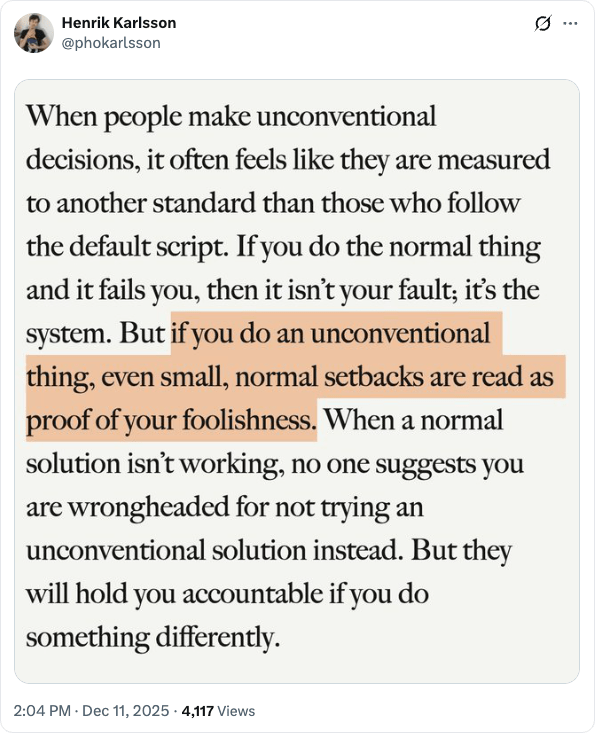
Definitely click through to read the full article because this is a wonderful description of what it feels like to go solo and go on an unconventional path. There are large parts of it to which I relate.
The highlighted part in the tweet is what caught my eye: "If you do unconventional things, even small, normal setbacks are read as proof of your foolishness."
I feel like I do a lot of unconventional things and some of them work and many of them don't. And I don't know if other people think I'm foolish, but I can apply this to myself quite often. I can say, well, if you just did the normal thing, you wouldn't be in this situation. I'm sure other people are thinking it, but that part doesn't super bother me.
Going off of the default path into something that is unconventional does come with those nagging questions at the back of your mind, wondering if you're foolish or brave.
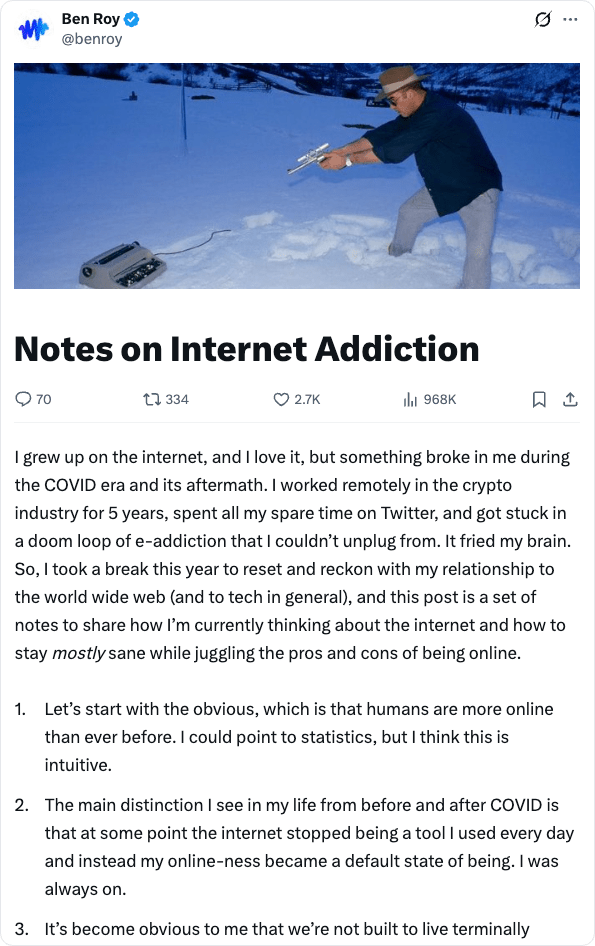
This is a very even-handed article written in a chaotic way. It's numbered, but I don't know why it's actually numbered like a list because… it's not a list. It makes good points about being terminally online without coming to the conclusion that the solution is to be a Luddite.
I'm very grateful to have a lot of close offline friends, and I think that's extremely healthy. We also have a good pattern of recurring offline activities. Church every Sunday. Church group every Thursday. I do breakfast with some guys pretty regularly. I do a supper club once a month.
I'm able to interact with my real friends quite often versus just living online all the time.
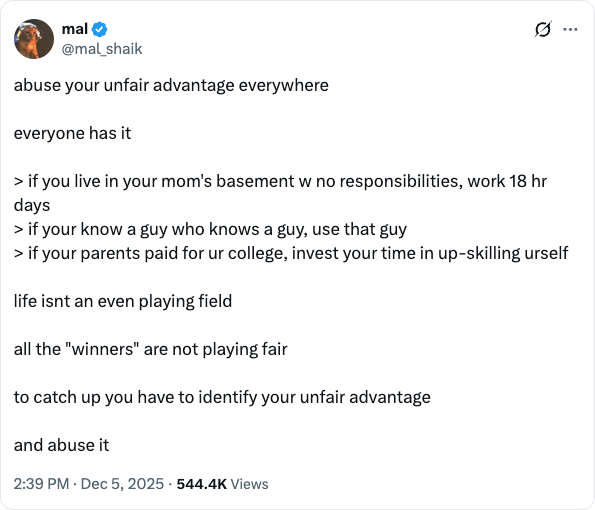
I think it's a good realization to bake into your psyche that life is not fair. I think that's good across the board. That also means that you have some unfair advantage. Maybe you have an easy day job. Maybe you don't have kids right now. Maybe you're super young and anything you do is viewed through a lens of, wow, that's impressive for such a young person. Maybe you're super old and it's viewed as, wow, that's impressive that they're still in the game. Whatever your unfair advantage is, you should leverage it as much as humanly possible. I don't think you win any morality points for being really good at something and not exercising it just because other people aren't good at it.
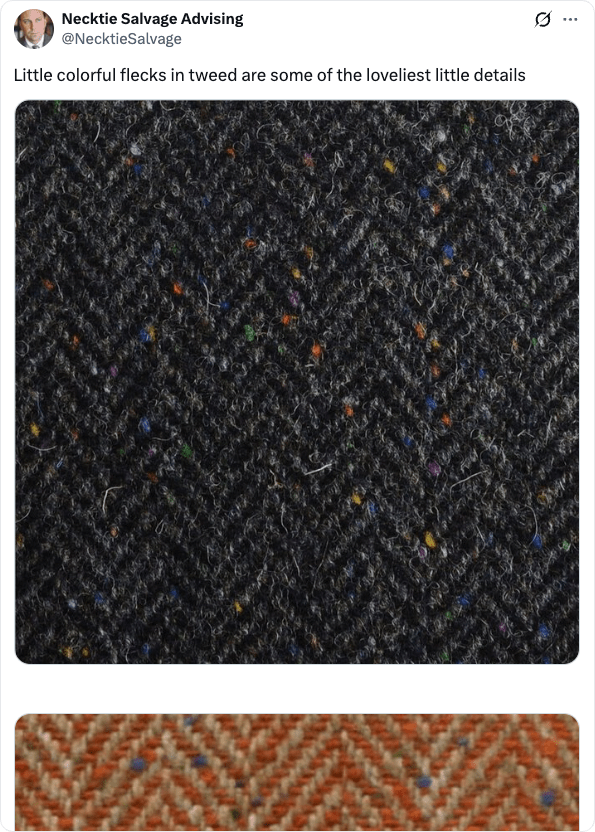
Not a lot to say here, except you should go look at these pictures and take some joy in the tiny details.
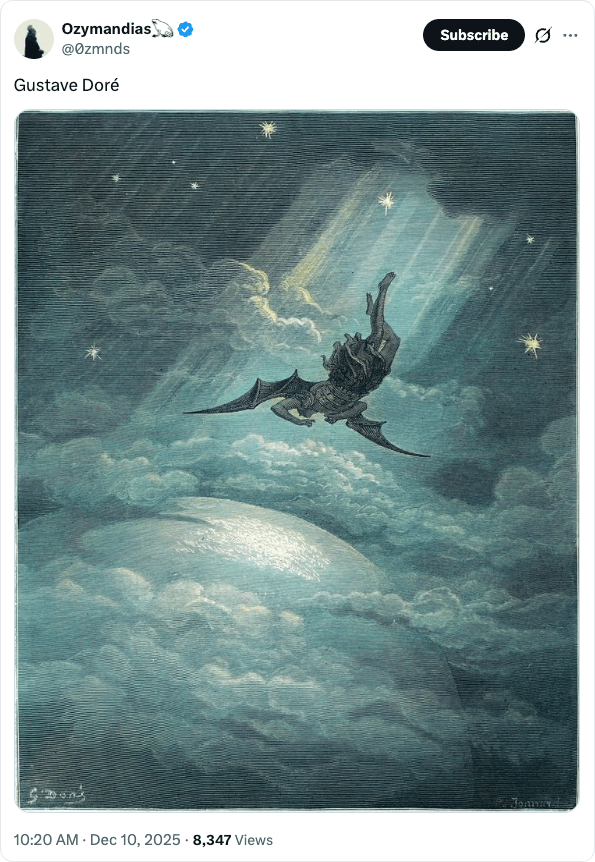
Ah, this is a newsletter classic! This is Gustave Doré depicting the fall of Satan.
I've had Icarus on my mind ever since that photo of the skydiver in front of the sun, which my co-host gifted me a print of. So the first time I saw this, I was sure that it was Icarus. And then I realized that the style was Gustave Doré and that he was a religious—primarily a religious artist—and pieced together that it was the fall of Satan.
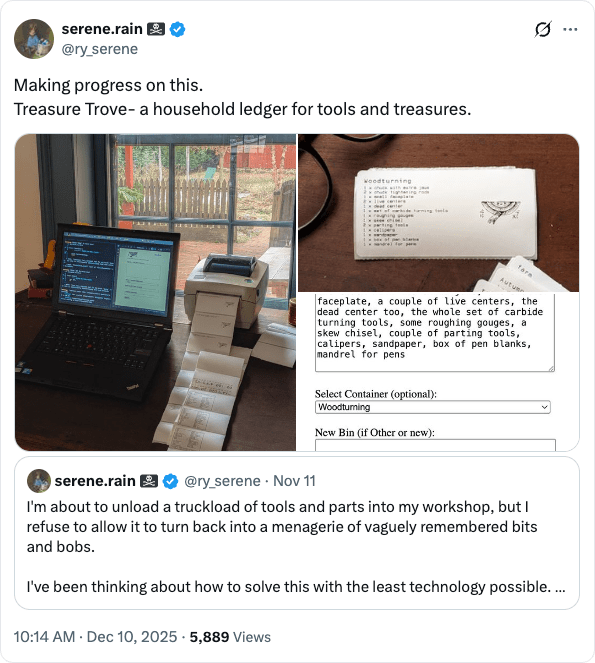
Practical things can be whimsical as well! One of my friends tagged me in on this, which just goes to show that the newsletter continues to be a source of friend catching and a way to surface inspiration.
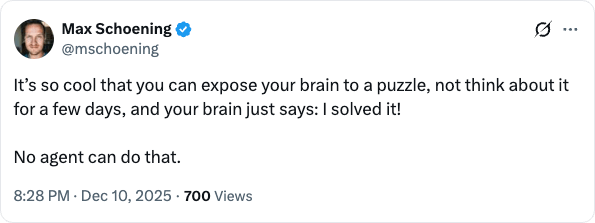
Leaving aside the agent part, this is one of, I think, my great superpowers! And can be anyone's great superpower. And that's background information processing or subconscious information processing. The sooner that you start on a problem and load it into your brain, the better chance you have of your brain coming up with a great solution when you're not thinking about it.
If you have to write a talk the day before you're going to give the talk, you don't give your brain enough time to piece together disparate threads. If you start a month early, there's no pressure because you still have a full month and you get your background wheels turning and your brain will surface important things such that when you sit down to write it a day before, you've already noodled on it for a super long time and now you can just put it on paper.
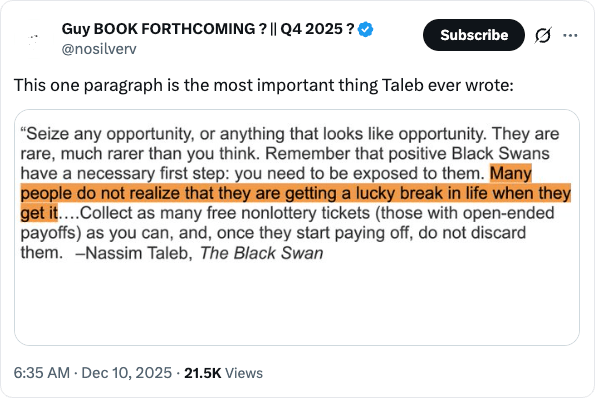
Ignore the highlighted part and focus on the part right after that that says collect as many free non-lottery tickets as you can.
I think we've talked about this in a past issue of the newsletter, but for games that are free to play that have unlimited upside, you should play them as often as possible. This is just further evidence in that same direction.
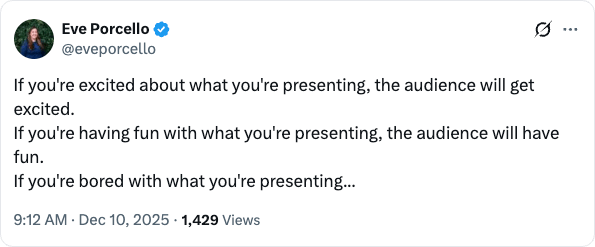
Fantastic advice for giving conference talks or really any sort of presentation. If you're bored when you get up there, people will be bored. If you don't really have anything that interesting or insightful to say, but you're thrilled to death about it, people will still think it's a good talk.
If you’ve been enjoying the newsletter and think a friend may enjoy reading it each week too, please forward it to them! They can sign up to receive it weekly here: https://aaronfrancis.com/newsletter.
That’s it for this week! I enjoy reading all of your replies, so if you see something interesting or just have a thought you want to share, please hit reply and let me know.
Talk soon,
Aaron
{{ ENV.unsubscribe_personal | default: visitor.unsubscribe_url | hyperlink: "Click here to unsubscribe." }}
